Sun Enters Sagittarius November 21 2012…. ☺

The Sun moves into the zodiac sign of Sagittarius

November 21 2012:

Free Clip Art Birthday : astrology symbol sagittarius Stock Photo

Sagittarius: Fire: Masculine: Mutable:

Sagittarius is optimistic, ruled by the planet Jupiter (Expansion). The enthusiasm of these wonderful people can spread like wildfire, engaging everyone they meet and spreading the wonder of life where ever they go. :)

Sometimes the quest for “more” can get out of control and become a challenging aspect of close personal relationships, as the desire to experience new places, people and things can be tiring to partners who are of a more sedate nature.

Routine can be boring for Sagittarius folk and don’t even think about taking Don’t try to hold them to you they will either leave or  you will likely end up in a relationship of misery…..  The number one need of a Sagittarius is FREEDOM….

We thank you Sagittarius for showing us how to live life to the fullest, for showing us how to have fun and how to laugh at ourselves and your belief that laughter truly is the best medicine….

Free Clip Art Birthday Cake : Friends celebrating birthday party

Happy Birthday to some wonderful Sagittarians I am blessed to know… Lori and Samantha… have a fabulous birthday ladies and an awesome year ahead….   if you are celebrating under this zodiac sign the folks at SGC wish you a Happy Birthday too….

FYI: From David Suzuki: Our Economy needs to include the value of nature and her resources.

From the Editor: FYI From our inbox to you…. the latest from David Suzuki and Friends: Our economic structure needs some changes to include the value of nature and her resources.

By David Suzuki

In early November, 70 Harvard University students walked out of their introductory economics class. They wrote to Prof. Gregory Mankiw that the biased nature of his course “perpetuates problematic and inefficient systems of economic inequality in our society.” Mankiw is the author of Principles of Economics, a textbook used by almost every economics student in the Western world.

The walk-out was part of a larger event organized by Boston’s Occupy protest, and it echoed a key element of the worldwide Occupy movement. Like these students and protesters, I’ve been thinking about our dysfunctional economic paradigm. I share the anxiety that we are sacrificing too much to a system driven by three fallacies: that well-being can only be measured in money, that distribution does not matter, and that the economy can grow forever. And like so many people today, I question whether our economic system is serving the goals that are important to society. After all, an economy is a means to prosperity, not the end.

This economic system is relatively new. In the 1930s and ’40s, world leaders had to address unemployment and underproduction. Many of our current economic measures were developed when natural capital (the benefits that nature provides) was plentiful but built capital (buildings, machinery, infrastructure) was not. In providing more manufactured goods and services, we developed a blind spot to the economic importance of natural systems. Labour, built, and financial capital are typically considered as the primary factors of production for economic development. Land and natural systems have seldom been included.

With growing human populations and profit-driven, consumer-based economics, more land is being eaten up by development, habitat is being destroyed and degraded, and resources are being exploited at unsustainable levels. Natural capital is disappearing.

For example, salmon were abundant on B.C.’s West Coast in 1900. More built capital, such as nets and boats, was required to harvest them for food. By 2000, there were no shortages of nets and boats, but the fish and the habitat they need to survive had become scarce. As natural capital and the goods and services it provides have diminished, interest in this area of economics has increased.

Economists are also starting to recognize that human well-being depends on more than having manufactured products. A great deal of research shows that things like leisure time, equality, and healthy relationships are more important to people’s happiness than greater consumption. This is starting to change our economic models.

But we still have far to go. The services provided by nature and the qualities that contribute to human well-being are still invisible in the marketplace. Because we have elevated economics above everything else, this is dangerous. When you have a society that largely equates the quality of life with economic indicators, such as gross domestic product, and those indicators fail to track the health of its fundamental inputs, you end up on shaky ground.

How do we address this? One tool is natural capital vauation. Putting a price on nature’s services is a complicated subject. Although nature’s full worth is unquantifiable, its ecosystems undeniably provide services to society that have real and tangible economic weight. For example, wetlands filter water and reduce natural disasters such as flooding, and forests manage water runoff and provide habitat for pollinators.

By making nature’s value visible, decision-makers can take into account the true benefits and costs of conservation and restoration. These economic benefits have even received the attention of the World Bank, which plans to assist countries in tracking natural capital assets and including them in development plans, in the same way we track other wealth using the GDP index. And more recently, former Canadian Prime Minister Paul Martin has advocated including natural capital in national accounts.

These measures won’t completely change our current economic paradigms, but they could at least slow the rampant environmental devastation and its consequent impacts on human health and well-being that are a symptom of our profit-driven corporate economies. They may also help us to think about what we truly need to be healthy and happy as humans, and to see the trade-offs inherent in our activities. Until we do this, we cannot hope to address the inequalities the students and the Occupy protesters are rallying against.

Written with contributions from David Suzuki Foundation environmental economist and policy analyst Michelle Molnar.

Learn more at www.davidsuzuki.org.

Photo credit alexindigo via Flickr.

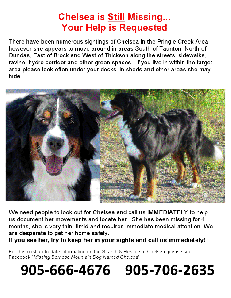
Chelsea the Missing Bernese Dog…

From the Editor:


So many people this past spring and summer have been actively involved in the search and hopeful rescue of Chelsea the beautiful Bernese Mountain dog who went missing January 2011.

There have been many sightings of Chelsea and because of the dedication and compassion of folk a lot of missing pets have been reunited with their families. Alas the rescue of Chelsea has not happened and her family still misses her very, very much.

And so as it stands to this date, Chelsea is still roaming free, the colder weather is upon now and Chelsea’s state of health is unknown, although the latest sightings state she looks thin and has an unkempt appearance. So, even though the “steam” behind the rescue of Chelsea may be running out, let’s not give up hope. Let’s still keep our eyes open and keep the phone numbers handy, just in case Chelsea decides to come for Christmas.

If you see Chelsea please call one of the following numbers right away.

905-706-2635 or 905-666-4676

For updates you may also view Chelsea’s Facebook page, search for

“missing Bernese mountain dog named Chelsea”

Whitby Block Parent Program to End: A new Chairperson is needed.

The Whitby block parent program has been in effect since 1978, but because of little or no community interest to continue, the program will have to end. 

Free Images Family : owl family Stock Photo

The block parent program encourages people to become involved and aware of what is going on within their local neighbourhood. Block parents provide a safe haven for lost or scared children, but is also available to anyone who may need assistance. Each block parent has a back ground check (including a criminal check) and once approved they are equipped with The Block Parent sign to be displayed in the window of the home. 

The biggest challenge facing the program now is the lack of a resident willing to accept the position of Chairperson. The responsibilities of the Chairperson include the following: 

  • Spreading awareness of the Block Parent Program
  • Recruiting more block parent homes
  • Ensuring participants are up to date on background checks
Anyone interested in taking over the position of the Chair and hopefully saving the program is asked to Whitby Block Parent office

FYI: Durham Region Recycles…

The Region of Durham’s Green Bin and blue Box waste diversion program provides new residents with a one time waste diversion kit. 


This kit includes one curbside green bin, one kitchen container and two blue boxes. If you are a first time homeowner in Durham, please contact the following numbers or visit www.durhamregionwaste.ca to order your free kit. 

905-579-5264 or 1-800=667-5671

If you are a resident of Durham and move to another region please take your green bins and blue boxes with you to your new home. 

Damaged green bins and blue boxes can be exchanged for new units at no cost. Please bring them into The Waste Management Centre at 4600 Garrard Rd. N. in Whitby, which is open from 8 am to 5 pm Monday to Friday. 

You are encouraged to have your waste out by the curb on your designated garbage pick up day, by 7 am.  Waste collection drivers have a route which may change, and drivers cannot go back to a street for late pick up once that street has been done. 

Source: Durham Works: